
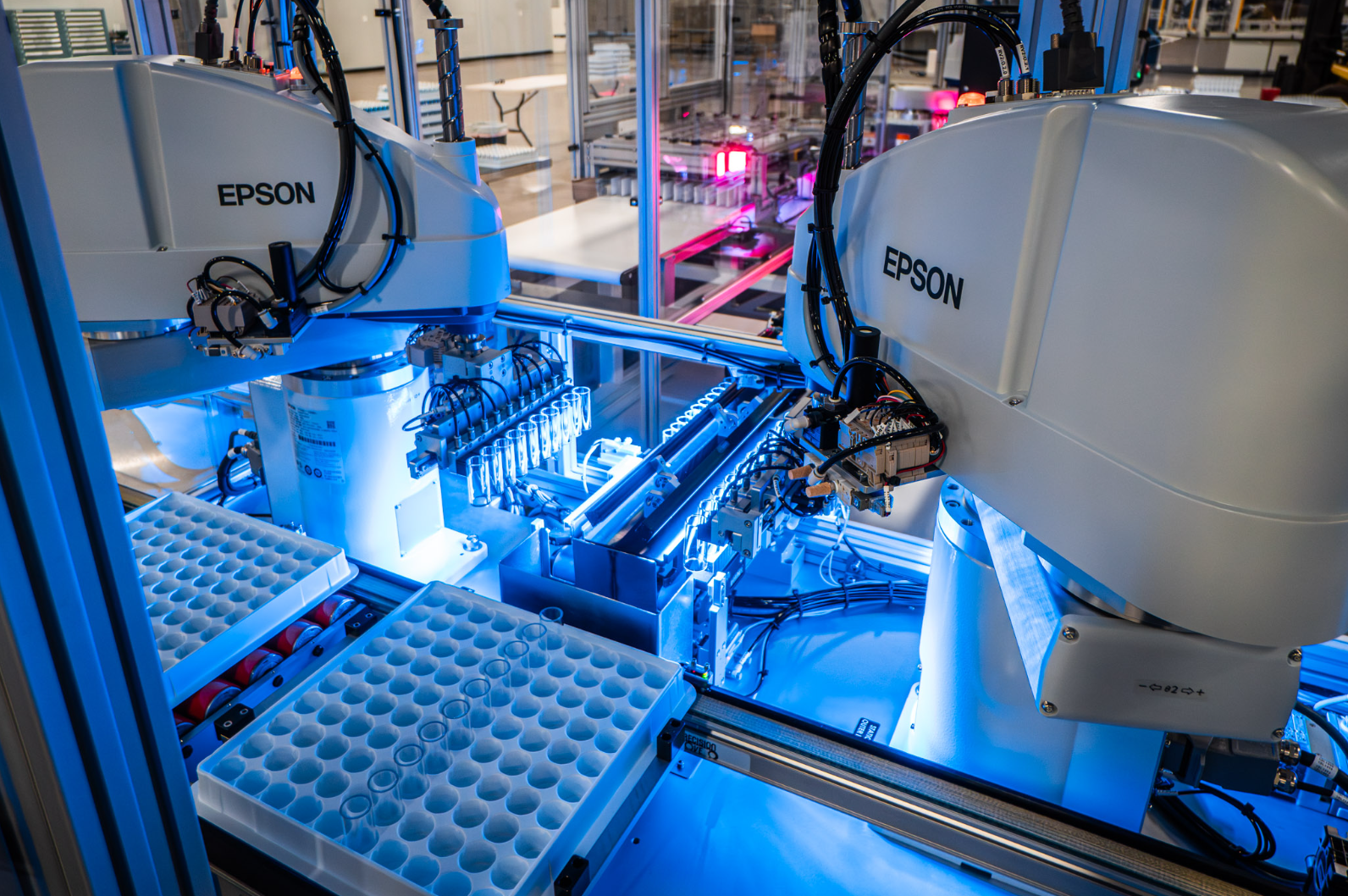
At its heart, fully integrated automation systems are an architectural strategy to eliminate disconnected systems. Integrated systems bring PLCs, HMIs, drives, and industrial devices into a unified software and hardware environment.
The high performance of integrated lines makes them a great model for all manufacturing automation goals. Explore a few top design lessons we can take away from fully integrated automation systems, whether you're designing a new production cell or modernizing an existing line, and regardless of your software architecture or the origin of your system.
1. EVERY PROCESS SHOULD BE CONNECTED
Manufacturing floor inefficiencies are often traceable to “islands of automation” where information is trapped inside isolated systems.
Perhaps a robot completes its cycle, but the inspection station doesn't automatically pass on results to the testing equipment. A PLC knows a fault occurred, but operators may need to hunt through multiple interfaces to diagnose it.
A well-integrated automation solution uses one connected environment where devices communicate and share data freely. That principle carries into the design of new, custom-integrated automation systems, too. Manufacturers allow for enormous floor time savings when they design robotics, inspection, testing, conveyors, and data collection as one coordinated system.
2. SINGLE-SOURCE ENGINEERING KEEPS THINGS SIMPLE
Traditionally, you’d need different software to program a Programmable Logic Controller (PLC) and to design a Human-Machine Interface (HMI). As a result, there’s a greater chance of tag mismatches and human error. Separate databases, duplicate tags, conflicting variables…all these small frustrations increase commissioning time.
The best approach is to use a centralized engineering database. When a variable, tag, or device is updated in one location, it dynamically propagates across the entire project. A consistent, integrated database prevents conflicting parameters and can even cut development time by up to 30%.
This lesson applies regardless of your chosen software platform: engineers move faster when the project has a single source of truth.
3. DESIGN FOR EXPANSION WITH MODULAR PROGRAMMING
It’s inevitable that manufacturing requirements change over time. Production may increase, necessitating additional inspection stations, and new product variants may also appear.
A modular engineering philosophy makes those changes easier. It’s possible to use modular coding to break logic down into small, self-contained functions and data blocks, which are saved in a global library. Because it’s so easy to reuse modular code, there’s no need to redesign an entire production line when adjustments are needed and equipment must be scaled.
Manufacturers can go ahead and deploy the same code and reusable logic across multiple production lines.
4. SOLVE PROBLEMS BEFORE STARTUP
Commissioning is an expensive phase for automation projects. You never want to find software conflicts or sequence problems after equipment has already arrived on the factory floor — the delays will ripple through production schedules.
Consider using virtual testing before physical commissioning. Engineers can make use of digital workflows to simulate a machine’s behavior before it’s built on the physical factory floor. Simulations give designers and developers time to validate logic and debugging workflows earlier on in the process.
Integrated software environments allow manufacturers to debug ladder logic or test I/O signals. One case study showed that virtual commissioning could provide 98% accurate production line simulation, all before any physical products reached the shop floor. Virtual workcell simulations reduced project cycles by 20-30%.
The lesson here is that the more problems you can solve before installation, the smoother commissioning will go.
5. STANDARDIZE DIAGNOSTICS AND MAINTENANCE
It’s costly to troubleshoot a stopped production line. It’s difficult for operators to search through multiple systems to determine which sensor failed or where a sequence stopped. Custom integrated automation solutions can more easily include built-in diagnostic functions.
What if your system were to include detailed diagnostic messages that automatically pass from the controller to the HMI or mobile devices whenever an error occurs? Maintenance teams could then instantly pinpoint exactly which sensor or drive failed, significantly minimizing Mean Time to Repair (MTTR). This is just one example of a way a custom, fully integrated manufacturing system can solve problems faster.
6. INTEGRATION IS BIGGER THAN SOFTWARE
Fully integrated automation is often associated with software integration, but manufacturers shouldn’t forget the hardware complexities.
Automation system integration requires extreme precision in physical processes as well. You’ll need to connect robotic handling with vision inspection. End-of-arm tooling has to be designed to maintain part orientation through downstream testing. Every transition in a production cell will be carefully engineered.
Work with an experienced automation system integrator to engineer complete manufacturing systems — hardware and software — that function as one coordinated process.
The technology behind automation continues to evolve, but the central lesson remains the same: you’ll achieve the best results with automation that is designed from the ground up to work as a fully integrated system.
FAQS
What is a fully integrated automation system?
A fully integrated automation system connects the hardware and software used throughout a manufacturing process so individual machines, controls, inspection systems, and data sources work as one coordinated production environment. Automation hardware and software within a unified development environment.
What is the goal of a fully integrated automation system?
The goal is to improve engineering efficiency, simplify communication between devices, reduce commissioning time, and create scalable automation systems.
What is automation system integration?
Automation system integration combines robotics, PLCs, HMIs, vision systems, testing equipment, conveyors, and software into one coordinated manufacturing system.
Why is automation integration important in manufacturing?
Automation integration helps eliminate manual handoffs between isolated systems. It also improves data flow, shortens troubleshooting time, and gives engineers better control over how the entire production line operates.
What do automation system integrators do?
Automation system integrators design, build, program, and commission complete manufacturing systems that connect multiple technologies into a unified production process.
How does integrated automation improve scalability?
Integrated systems use standardized designs and reusable programming approaches that make it easier to expand production or add new equipment later.
Can fully integrated automation systems include existing equipment?
Yes. Existing robots, machines, inspection systems, and controls can often be incorporated into a larger integrated system if the equipment is compatible with the new controls architecture and production requirements.
How do fully integrated automation systems simplify maintenance?
Integrated diagnostics can route fault information through the system so maintenance teams can identify the source of a problem faster. Centralized controls and shared data also reduce the need to troubleshoot each machine as an isolated unit.