
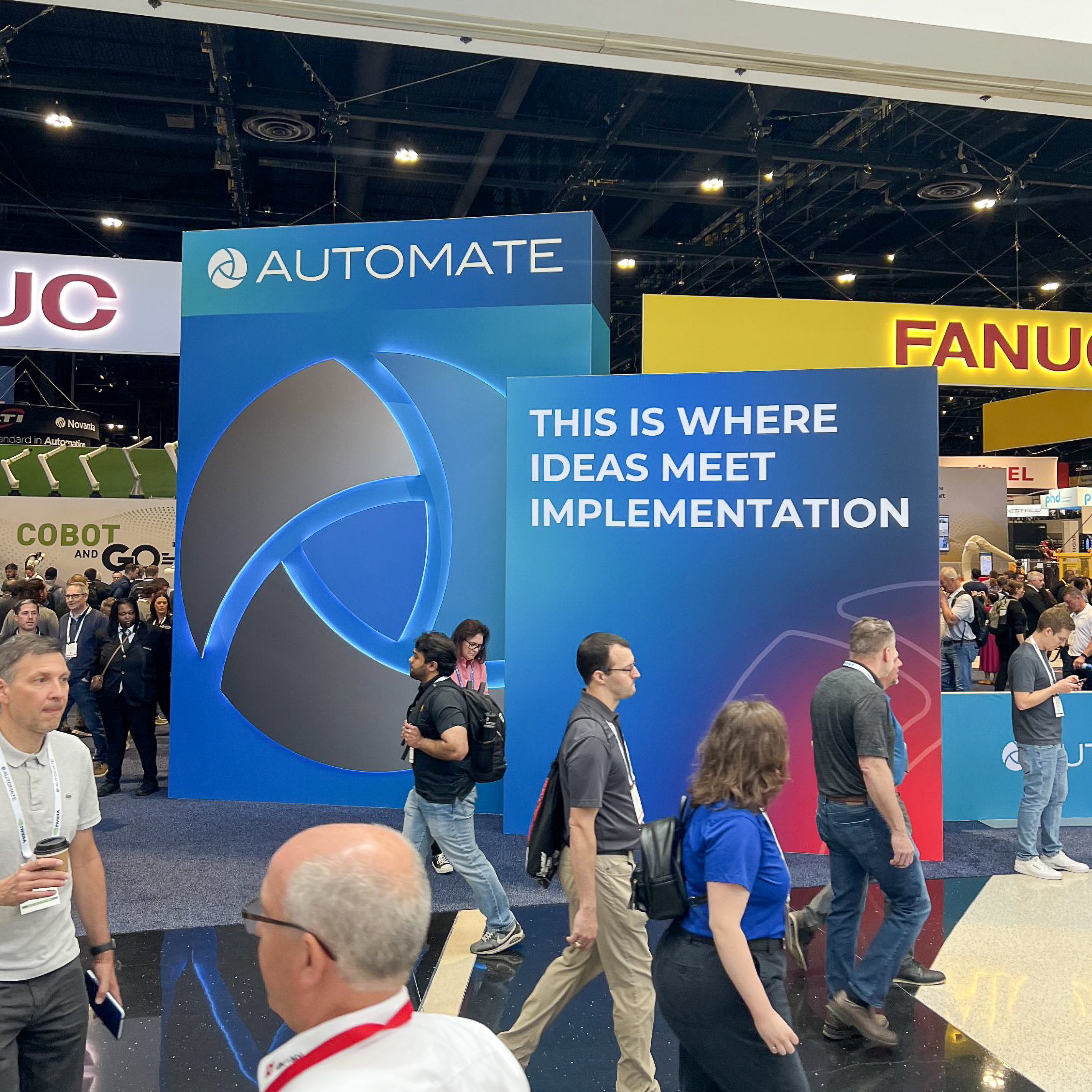
Automate 2026 in Chicago was a great reminder of how quickly the automation industry is moving.
For us at Jerit Automation, trade shows like Automate are not just about walking the floor and seeing new products. They are about paying attention to where the industry is headed, what technologies are becoming more practical, and how those advancements can be used to build better automated manufacturing systems for our customers.
This year, a few themes stood out to me: industrial robots are becoming more capable and easier to work with, manufacturing data software is becoming more important to production performance, vision systems are getting more flexible, safety technology is improving without limiting output, and AI is starting to find its place in real-world automation.
Here are the biggest things that stood out to me from Automate 2026 and why I think they matter for the future of manufacturing automation.
1. Robots Are Becoming More Capable
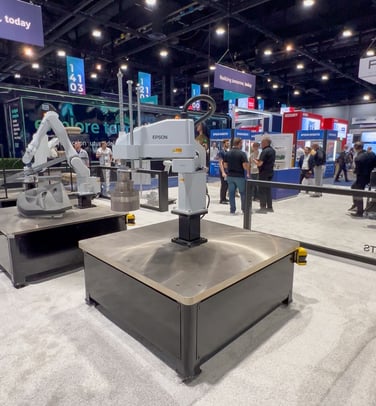
Industrial robots have been a major part of manufacturing automation for a long time, but the most exciting improvements I saw were not just about speed. They were about usability, flexibility, payload, articulation, and reach.
As automation integrators, programming and commissioning time matter. A robot can be incredibly powerful, but if it takes too long to program, debug, or adapt to a real production environment, that creates challenges for both the integrator and the end user.
At Automate 2026, it was clear that many robot manufacturers are focusing heavily on better programming interfaces and easier setup. That is a big deal. Better programming tools help shorten development time, reduce commissioning headaches, and make robotic automation more practical across a wider range of applications.
We also saw continued improvements in payload capacity, articulation, and reach. That opens the door for more flexible robot cells, especially in applications where part size, tooling weight, or machine layout previously limited what was possible.
At Jerit Automation, we already work with trusted robotics partners like Epson, Kawasaki, and Mecademic, and we are always paying attention to how robot platforms are evolving. The better these tools get, the better we can apply them to real manufacturing problems.
2. Data Software Is Becoming a Core Part of Automation
One of the biggest takeaways from the show was how important data software has become in manufacturing automation.
A machine can be mechanically impressive and still leave a manufacturer guessing if it does not provide useful production data. Raw data by itself is not enough. Manufacturers need information that helps them understand uptime, downtime, cycle time, quality, throughput, scrap, and overall equipment effectiveness.
That is where modern data software becomes valuable.
The most interesting tools I saw were focused on taking raw machine and production data and turning it into reports, dashboards, visuals, and insights that help manufacturers make better decisions. This is especially important for improving OEE and identifying where production losses are actually happening.
This is an area we are especially excited about because it lines up directly with the work we are doing with Ignition, Allen Bradley, databases, and reporting systems to offer world-class SCADA systems. A well-built automation system should not only run the process. It should help the customer understand the process to assist with data-driven decision making.
3. Vision Systems Are Getting More Flexible and User Friendly
Machine vision has always been one of the most important parts of modern automation, but it can also be one of the most challenging.
Lighting, part presentation, calibration, inspection logic, and programming complexity can all determine whether a vision system is reliable in production. At Automate 2026, I saw a lot of encouraging movement toward vision tools that are lighter weight, more open, and easier to program.
That matters because vision is no longer just about pass/fail inspection. Vision is being used for robot guidance, barcode verification, dimensional checks, presence detection, defect inspection, traceability, and adaptive automation.
We work with trusted vision partners like Keyence and Cognex, and those tools continue to be extremely valuable in real production environments. What stood out at the show was the broader industry push toward making vision systems more accessible and flexible.
For manufacturers, better vision systems can mean fewer manual inspections, better quality control, faster feedback, and less dependency on operators catching issues after the fact.
4. Safety Technology Is Improving Without Holding Back Production
Safety is one of the most important parts of any automated manufacturing system, but it has to be done correctly.
At Automate 2026, I saw several safety improvements focused on reducing risk to people while still allowing machines to operate efficiently. This included better sensing, smarter guarding concepts, more advanced safety devices, and improved ways to manage human interaction with automated equipment.
This is an important area for manufacturers because more automation means more interaction between operators, maintenance teams, robots, conveyors, tooling, and moving equipment.
At Jerit Automation, this is something we think about constantly. Every machine needs to be productive, but it also needs to be maintainable, serviceable, and safe for the people working around it every day.
5. AI in Automation Is Moving from Buzzword to Practical Tool
AI was everywhere at Automate 2026, and like any new technology trend, some of it was more practical than others.
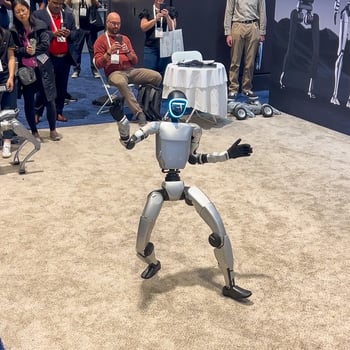
What was exciting to see was the number of companies working on AI offerings that could eventually help automation integrators build better machines. AI has potential in areas like vision inspection, robot guidance, predictive maintenance, production analytics, programming support, anomaly detection, and troubleshooting.
For us, the question is not, “How do we use AI just to say we are using AI?”
The better question is, “Where can AI make a machine more useful, more flexible, easier to support, or better at solving a real manufacturing problem?”
That is the lens we look through as an integrator.
Some AI tools may help simplify programming. Others may help identify production patterns that are hard to see manually. Some may make inspection systems more adaptable. Others may help operators and engineers understand machine performance more quickly.
There were a lot of interesting companies at the show exploring these ideas, including companies we do not currently use as suppliers but found worth paying attention to, such as Hellbender, Deltia.ai, Myrex, Planar Motor, and others.
Not every new technology will be the right fit for every project, but part of our job is staying close enough to the industry to know when a new tool becomes practical and valuable.
What Manufacturers Might Have Missed
The biggest thing people may have missed at Automate 2026 is that the future of automation is not about one single product or one single trend.
It is not just robots.
It is not just AI.
It is not just vision.
It is not just software.
It is not just safety.
The real opportunity is in how all of these technologies work together.
A world-class automated manufacturing system brings together robotics, controls, safety, machine vision, data software, motion, pneumatics, sensors, tooling, and operator interfaces into one coordinated process. That is where the real value happens.
That is also why attending shows like Automate matters to us.
We want to understand what is improving across the industry so we can continue building better systems for our customers. Whether it is a better robot interface, a more flexible vision tool, a smarter reporting platform, or a safety device that improves machine access without hurting output, those advancements can shape how we design the next generation of automation equipment.
Why This Matters to Jerit Automation
At Jerit Automation, we are focused on building custom automation systems that solve real manufacturing problems.
That means we have to stay current. We have to know what technologies are available, which ones are ready for production, and which ones are still developing. We also have to understand how to bring multiple systems together into machines that are reliable, maintainable, and useful for the people running them.
Automate 2026 was a great opportunity to see where the industry is headed and evaluate how those technologies could help us deliver even better machines.
We left Chicago excited about the future of manufacturing automation and even more confident that the companies who invest in smarter, more connected systems will be the ones best positioned to improve throughput, quality, safety, and long-term production performance.
The industry is moving quickly, and we are making sure Jerit Automation stays ahead of the curve.