
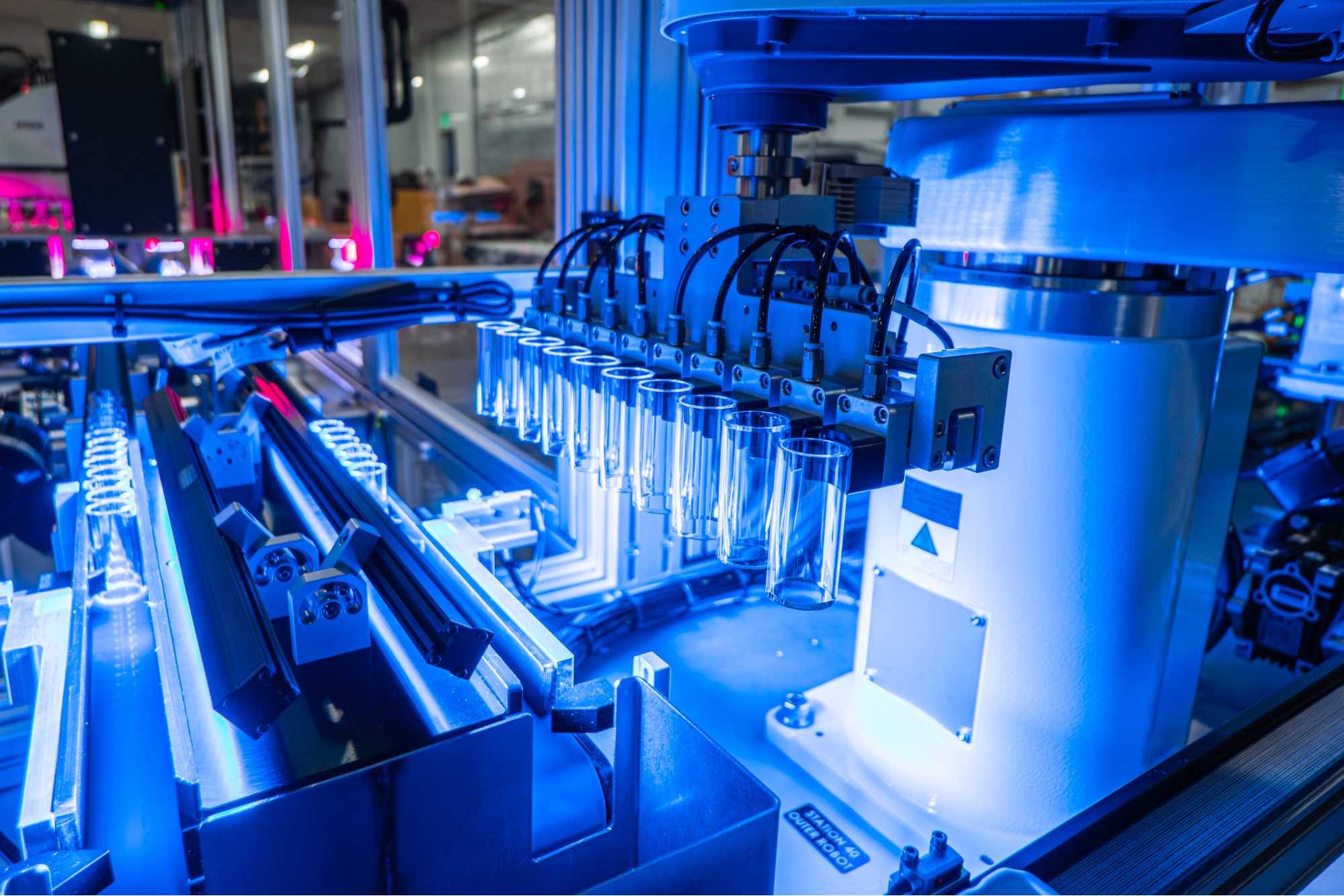
Production throughput and quality control are in something of a tug of war in manufacturing. Faster output is more profitable, but careful inspections take time. However, high throughput means very little if it leads to inspection failures or other downstream issues. Scrap, rework, and customer complaints are more costly than getting things right.
Manufacturing automation solutions address both priorities at once.
Fully integrated, end-to-end automation systems connect everything — robotics, inspection, testing, handling, and production flow — into a coordinated workflow within a single, self-contained automation cell. Manufacturers rely on these start-to-finish solutions to streamline repeatable processes and scale up throughput. At the same time, they’re increasing the precision and consistency of inspection and compliance processes.
These benefits have not gone unnoticed. A 2026 industry outlook from PwC found that manufacturers expect the share of highly automated processes to rise from 18% today to 50% by 2030. Leading manufacturers expect that number to reach 65%.
HOW AUTOMATION BOOSTS PRODUCTION THROUGHPUT
It’s natural to think about machine speed when trying to improve manufacturing throughput. And yet, the larger issue usually sits between processes.
Consider part orientation as an example. Are your parts coming out of the press and going into a bin or a bag? When parts lose orientation and pitch after molding, operators have to take time to manually separate or reposition components for accurate inspection and other downstream stages. This is a bottleneck. Inspection stations experience queues that slow the entire line and packaging cannot keep pace with upstream output.
Manufacturing and automation systems engineer those transitions into a continuous, integrated process that keeps parts oriented for following stages. Press side automation, robotic handling, automated inspection, and conveyor integration all help manufacturers maintain consistent flow from one production stage to the next. Less manual intervention increases repeatability and speed at the same time that it accelerates inspections and packaging.
Integrated systems also simplify scaling production later. Where in the past, you may have needed to redesign disconnected manual steps each time output increased, an automation cell allows manufacturers to expand infinitely because the engineering is already complete and designed to meet throughput goals. Need more products? Install more cells.
HOW AUTOMATION IMPROVES INSPECTION CONSISTENCY
Manual inspections are a consistency challenge. There may be variability between shifts, operators, fatigue levels, and each of their inspection speeds. Even in automated inspection systems, if this step is not seamlessly integrated into the line, it requires manual transitions and setup after products are pressed.
Integrated manufacturing automation solutions standardize all inspection processes — vision inspection systems, automated testing equipment, barcode verification, and AI-assisted inspection tools — so you can evaluate parts right on the line as they move through production (as opposed to with isolated downstream checks).
Regulated manufacturing environments may require automated compliance support for things like FDA and ISO traceability, GAAP and Sarbanes-Oxley financial controls, and audit documentation. Automated systems help manufacturers embed regulatory requirements right into workflows for stronger audit trails and reporting consistency.
For medical, pharmaceutical, aerospace, and electronics manufacturers, integrated inspection systems are a big confidence booster for quality control and quality assurance.
LABOR CONSTRAINTS CONTINUE TO PUSH AUTOMATION FORWARD
Throughput problems do not always come from equipment limitations. Staffing shortages affect production capacity too.
Supply Chain Management Review reported that 76% of supply chain operations experienced notable workforce shortages, while 61% described shortages as extreme. As Chris Jones, EVP of industry at Descartes, explained the challenge:
“The workforce problem is pervasive, and the study confirms that most supply chain and logistics organizations have made changes to their operational, technology, recruitment and retention strategies to help combat the issue. Based on the results of the study, we believe that employers should continue to invest and evolve to get the most they can from their existing resources and focus on more than money to hire and retain a capable workforce.”
Automation in manufacturing is one of the most impactful ways companies can stabilize output even when labor availability fluctuates. Robotics, automated handling systems, and integrated inspection all reduce dependence on repetitive manual processes that are difficult to staff in a tough labor market.
AUTOMATION PROJECTS CONTINUE EXPANDING WITH ROI IN MIND
Manufacturers are investing heavily in automation systems because the long-term production advantages continue to grow.
Packaging Technology Today has found that 84% of consumer packaged goods companies already operate robotics somewhere on their lines, with adoption expected to rise to 93% within five years. However, at present, only one-third of CPG companies have robots on more than 50% of their lines, and one-fourth have equipped less than 10% of their lines. There’s plenty of opportunity to continue growth and end-to-end integration of all processes.
A study highlighted in MIT Science Policy Review examined the financial impact of replacing manual labor with robotics during nucleic acid testing sample collection. Researchers found that automation became cost-effective after 454 days when a single robot replaced one worker and after just 137 days when multiple robots replaced twice as many workers. The study concluded that “the payback period on a large initial investment was surprisingly short” and noted that higher levels of automation may help reduce consumer costs over time.
ARE YOU INTERESTED IN FULLY INTEGRATED, CUSTOM MANUFACTURING AUTOMATION SOLUTIONS?
The results of studies like these suggest it may be implementation complexity, and not ROI uncertainty, that is the biggest concern holding back adoption. Experienced automation integration partners are needed for their expertise in addressing custom production requirements, inspection challenges, and scalability planning.
Get in touch with Jerit Automation today and share the details of your automation needs. We handle it all: robotics, inspection systems, product handling equipment, testing systems, and data acquisition, and integrate everything into unified manufacturing automation solutions.
FAQs
What are manufacturing automation solutions?
Manufacturing automation solutions are integrated systems that use robotics, conveyors, inspection equipment, testing systems, and software controls to automate production processes.
How does automation improve throughput?
Automation improves throughput by reducing manual handling, maintaining continuous production flow, minimizing bottlenecks, and increasing repeatability across manufacturing operations.
Can automation improve quality control?
Yes. Automated inspection systems help manufacturers standardize QA processes, reduce human inspection variability, and detect defects earlier during production.
What industries benefit most from manufacturing automation?
Medical, pharmaceutical, electronics, automotive, aerospace, packaging, and high-volume manufacturing operations commonly benefit from automation systems.
What is automated manufacturing?
Automated manufacturing uses robotics, controls, software, and integrated production systems to reduce manual labor and improve production consistency.
Why are manufacturers increasing automation investments?
Manufacturers are increasing automation investments to improve throughput, reduce labor dependency, support scalability, and maintain stronger production consistency.
Do manufacturing automation companies build custom systems?
Many manufacturing automation companies develop custom systems designed around a manufacturer’s specific products, inspection requirements, production goals, and facility layout.
How long does it take for automation systems to show ROI?
ROI timelines vary by application, but studies show many automation systems recover costs within months or a few years through labor savings, higher throughput, and reduced production inefficiencies.