
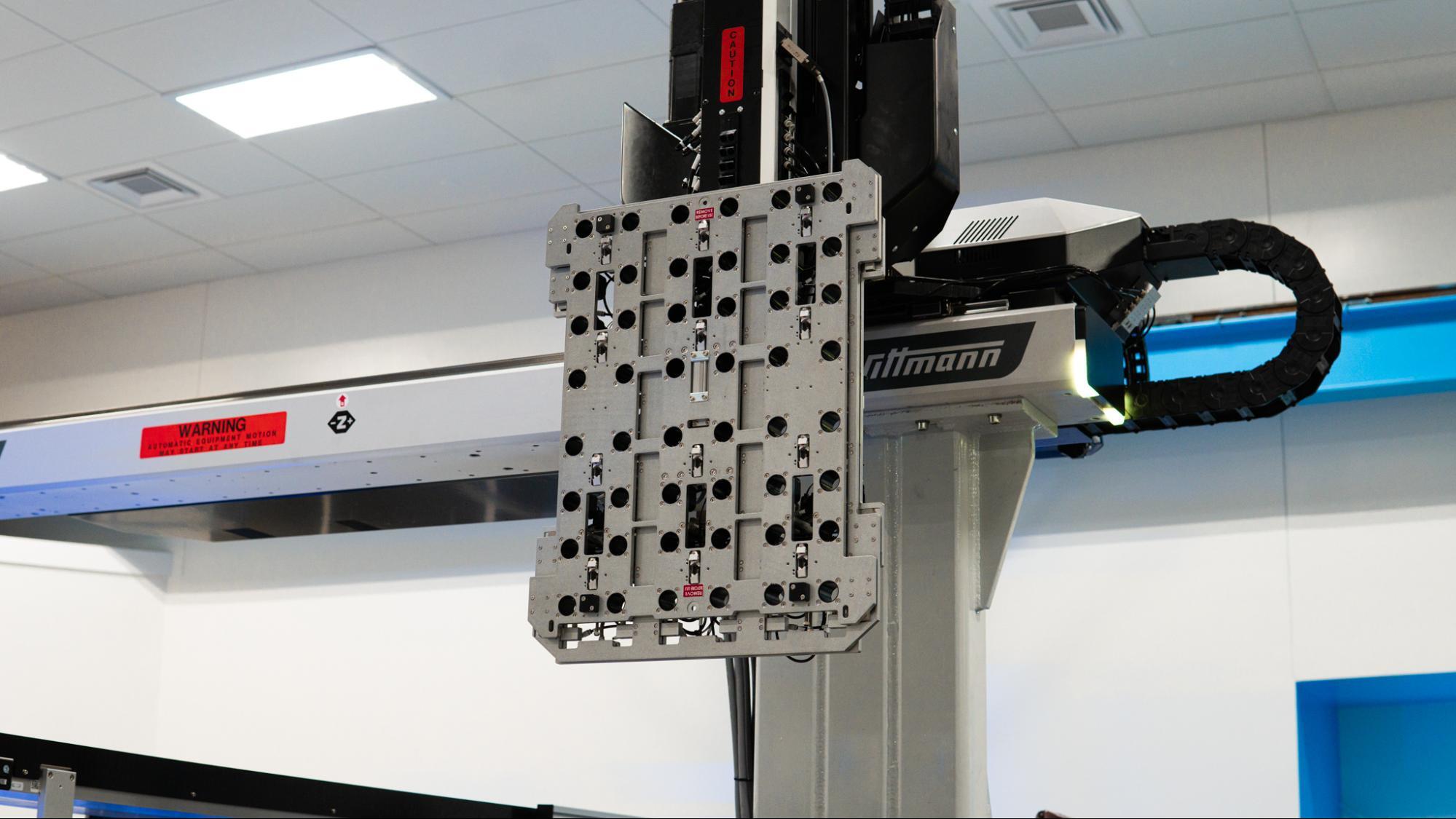
For robots, part handling is only as good as the tool at the end of the arm. That may sound obvious, but it drives almost every conversation we have with customers.
The larger components of the robot are the easy part — machine frame, servo motors and gearboxes, articulated sections between joints, etcetera. The real challenge is to figure out how to grab a freshly molded component in a way that will be precise, fast, secure, consistent, and safe for delicate parts. Parts need to maintain orientation from extraction through inspection. It’s a long list of wants.
And they all come back to end-of-arm tooling (EOAT).
ROBOT END-OF-ARM TOOLING: START WITH THE PART
Customers sometimes come to us asking about a particular robot platform. Six-axis. SCARA. Gantry. Our first questions are usually about the part.
- How does it come out of the mold?
- Where does it need to go next?
- What features can we safely grip?
- Does orientation matter?
- Can the part tolerate vacuum handling?
- Can it tolerate mechanical contact at all?
The tooling strategy comes from those answers, and in a custom automation system, they’ll drive our recommendation or selection of a robot for the job. If you’ve already got a robot in place and need to make the arm tooling work, this conversation will help establish limitations and parameters.
FOR ROBOTS, EFFICIENCY IS ALL ABOUT ORIENTATION
A lot of the automation systems we build involve injection molded plastic components. The moment those parts leave the mold, every handling decision impacts cycle times and throughput.
If you drop those parts into a bin or tote, you've created a sorting problem. Because you’ve lost orientation, the part needs to be individually repositioned before press side processes like inspection or packing can begin. The introduction of spatial variability costs you production speed. It may require additional manual handling steps or create more opportunities for jams or misfeeds.
Thoughtful end-of-arm tooling on the press side can protect against those problems. That could mean custom grippers or vacuum tooling. In other situations, it may take a combination of approaches that preserve orientation through every unique handoff in the process.
At Jerit, we design end-of-arm tooling as part of the larger manufacturing system so parts move from molding to inspection, testing, laser marking, assembly, and packaging without losing orientation along the way.
TOOLING HAS TO WORK WITH THE ENTIRE CELL
A tooling order looks like a standalone purchase, so we get it, but remember that the gripper isn't working alone.
The end of arm may interact with vision systems. It has to present parts for testing equipment and fit inside guarding. It has to clear fixtures. Cycle time requirements that motivated upstream or downstream robotic decisions will impact how the arm must work at this stage to keep pace.
The Jerit team always treats end-of-arm tooling with a holistic view, as a part of the larger automation system. A gripper that does the job on a bench, out of context, may be a bottleneck once it enters a production environment.
END-OF-ARM-TOOLING MANUFACTURERS KNOW RELIABILITY WINS
Speaking of grippers, a gripper that works during a demo is not the same thing as a gripper that works after 2 million cycles.
Tooling has to survive wear surfaces, contamination, compressed air quality, maintenance access, part variation, cycle time requirements, and more. All of these must be taken into account during design.
We've seen applications where a gripping surface gradually wears and starts introducing misalignments or positioning errors. We've seen vacuum systems lose performance because no one anticipated dust accumulation. Tooling that worked great on the last iteration of a part prototype could struggle with dimensional variation in the next.
We spend a lot of time considering where the tooling will make contact and how components will wear over time. There’s got to be an efficient plan in place for how maintenance technicians will access the system, too, when service is eventually required.
A complicated end-of-arm tool is never the goal. You’ll want one that performs the same way on cycle 2,000,000 as it did on cycle 2. The guiding philosophy is “minimum opportunities for failure” in every design decision. End-of-arm tooling is precise, thoughtful work.
When customers bring us a difficult handling challenge, they’re not looking for a catalog part. We’re ready to innovate.
Want to take a closer look at what’s possible with end-of-arm tooling for robots? Explore our gallery of recent projects at Jerit Automation.
FAQs
What is end-of-arm tooling?
End-of-arm tooling (EOAT) is the device attached to the wrist of a robot that physically interacts with the part being handled. Examples include grippers, vacuum tooling, pneumatic devices, nippers, and custom-built handling mechanisms.
How do I choose the right end-of-arm tool?
The right end-of-arm tool depends on the part itself. Geometry, material, weight, surface finish, orientation requirements, and downstream manufacturing processes all influence tooling selection.
What is the difference between a gripper and end-of-arm tooling?
A gripper is one type of end-of-arm tool. End-of-arm tooling is the broader category that includes vacuum systems, custom fixtures, nippers, sensors, tool changers, and other devices mounted to a robot arm.
Can end-of-arm tooling maintain part orientation during manufacturing?
Yes. In many automation applications, maintaining orientation is one of the primary goals of the tooling design. Properly designed EOAT can keep parts aligned from extraction through inspection, testing, assembly, marking, and packaging.
What industries use end-of-arm tooling for robots?
End-of-arm tooling is used across medical device manufacturing, pharmaceutical production, plastics processing, electronics assembly, automotive manufacturing, aerospace applications, packaging operations, and many other industries.
Can existing robots be upgraded with new end-of-arm tooling?
Often, yes. Many manufacturers improve performance by replacing outdated tooling while keeping the existing robot platform. The feasibility depends on payload limits, reach requirements, cycle times, and the overall automation cell design.
How long does custom end-of-arm tooling last?
Service life depends on cycle counts, materials, operating conditions, maintenance practices, and contact surfaces. A well-designed system should maintain reliable performance through millions of production cycles with routine maintenance and replacement of wear components.
Why work with custom end-of-arm tooling manufacturers instead of buying a catalog solution?
Catalog tooling works well for common handling tasks. Custom end-of-arm tooling becomes valuable when parts have unusual geometries, strict orientation requirements, delicate surfaces, tight tolerances, or integration requirements that standard products cannot address effectively.