
How quickly will your team notice if a measurement drifts slightly out of tolerance? The cost of manufacturing mistakes and defects only goes up with production volume — and even more so when quality issues don’t surface until later in production. What if a solder joint passes manual inspection but fails later in the field?
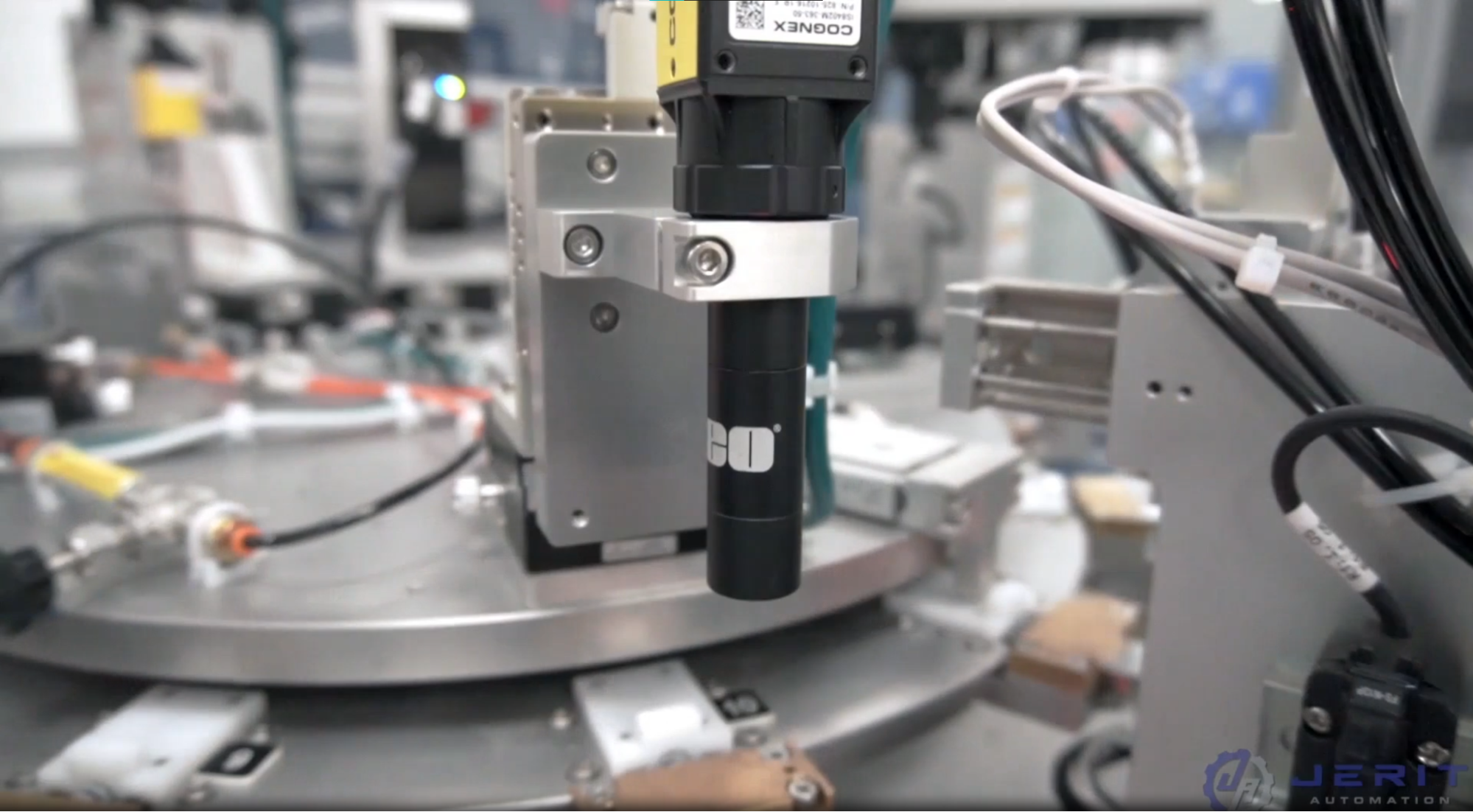
A custom automated vision inspection system helps catch those red flags earlier, with more consistency, and at far greater speed than manual inspection methods. With custom automation in place, facilities are often able to demonstrate higher throughput and lower labor costs. Better yet, there’s a faster return on investment for automation than most upgrades manufacturers can make.
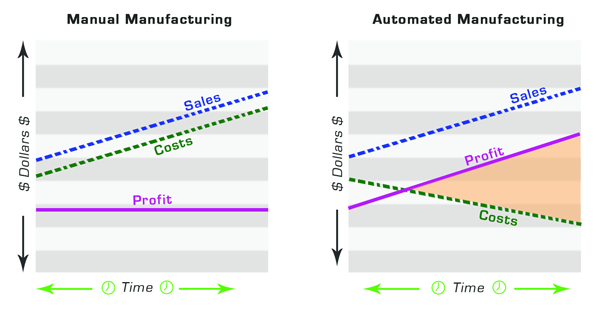
IMAGE SOURCE: ASSOCIATION FOR ADVANCING AUTOMATION
ROI FACTOR #1: MANUAL INSPECTION HAS HUMAN LIMITS
Human inspectors bring experience and judgment to quality control, but manual inspection creates challenges in high-volume manufacturing.
People get tired, and there will naturally be some differences in how individual human operators evaluate parts. Inspection speed could vary from shift to shift, too. Inspection may become a bottleneck that limits throughput as production volume increases.
According to Metrology News, only about 20% of manufacturing sites currently rely on automated inspection processes for medium and large parts, which has caused a number of QC issues for manufacturers. That leaves many manufacturers dependent on manual inspection methods, despite the inconsistencies and potential production delays. A custom vision inspection system helps standardize quality verification across every shift, every operator, and every production run.
ROI FACTOR #2: ENHANCED DEFECT DETECTION IN MINIATURIZED PARTS
Many modern products have become too complex for manual inspection alone.
Electronics manufacturers are a good example: industry research shows smartphone circuit boards have increased component densities by 35% since 2024. Inspection requirements for pitches below 0.3 mm continue pushing manufacturers toward advanced automated vision inspection systems capable of evaluating features that are difficult for human operators to inspect with their eyes or manual magnification tools.
The same challenge appears in medical devices, precision plastics, aerospace components, and other high-tolerance applications.
An automated vision inspection system can evaluate everything, all at once and in a continuous fashion:
- Dimensions
- Orientation
- Contamination
- Assembly accuracy
- Surface defects
- Markings
- Pass/fail criteria
In older inspection methods, facilities needed to sample a small percentage of output as a matter of raw volume. Automated vision inspections give manufacturers confidence that every part has had eyes on it as it moves through the process.
ROI FACTOR #3: FAST-PACED INSPECTIONS BOOST THROUGHPUT
Where manual inspections can slow down production, a custom automated vision inspection system operates at full production speeds. Inspection occurs as parts move through the manufacturing process rather than stopping for manual review.
Mordor Intelligence has found that In EV battery manufacturing, many facilities will now even require 100% inline 3D inspection of solder joints. This is because modern inspection systems can identify micro-cracks and voids in under 1 second per joint.
The combination of speed and accuracy eliminates one of the most common manufacturing bottlenecks: inspection queues.
ROI FACTOR #4: AI HAS EXPANDED INSPECTION CAPABILITIES
Artificial intelligence and AI-enabled predictive analytics have made industrial vision inspection even more valuable than it already was.
In Japanese factories retrofitted neural-network modules (on existing cameras and inspection tools), research shows that false calls have been cut by 40% and real defect catch rates have gone up 25-30% — a compelling return on investment.
FULLY INTEGRATED AUTOMATION DELIVERS THE MOST ROI
Manufacturers sometimes begin with stand-alone cameras or internally developed inspection solutions. Those systems may solve a specific problem, but they also introduce new challenges: maintenance, integration limitations, inconsistencies in data collection, future scalability, etc.
As an alternative, manufacturers can opt for fully integrated custom vision system automation.
This complete solution includes robotics, part handling, testing equipment, conveyors, reject sorting, traceability systems, and production reporting, all in one self-contained continuous system. The long-term savings generated by end-to-end automation because quality control, throughput, labor efficiency, and traceability improve together.
Want to take a closer look at what’s possible? Explore our gallery of recent projects at Jerit Automation.