
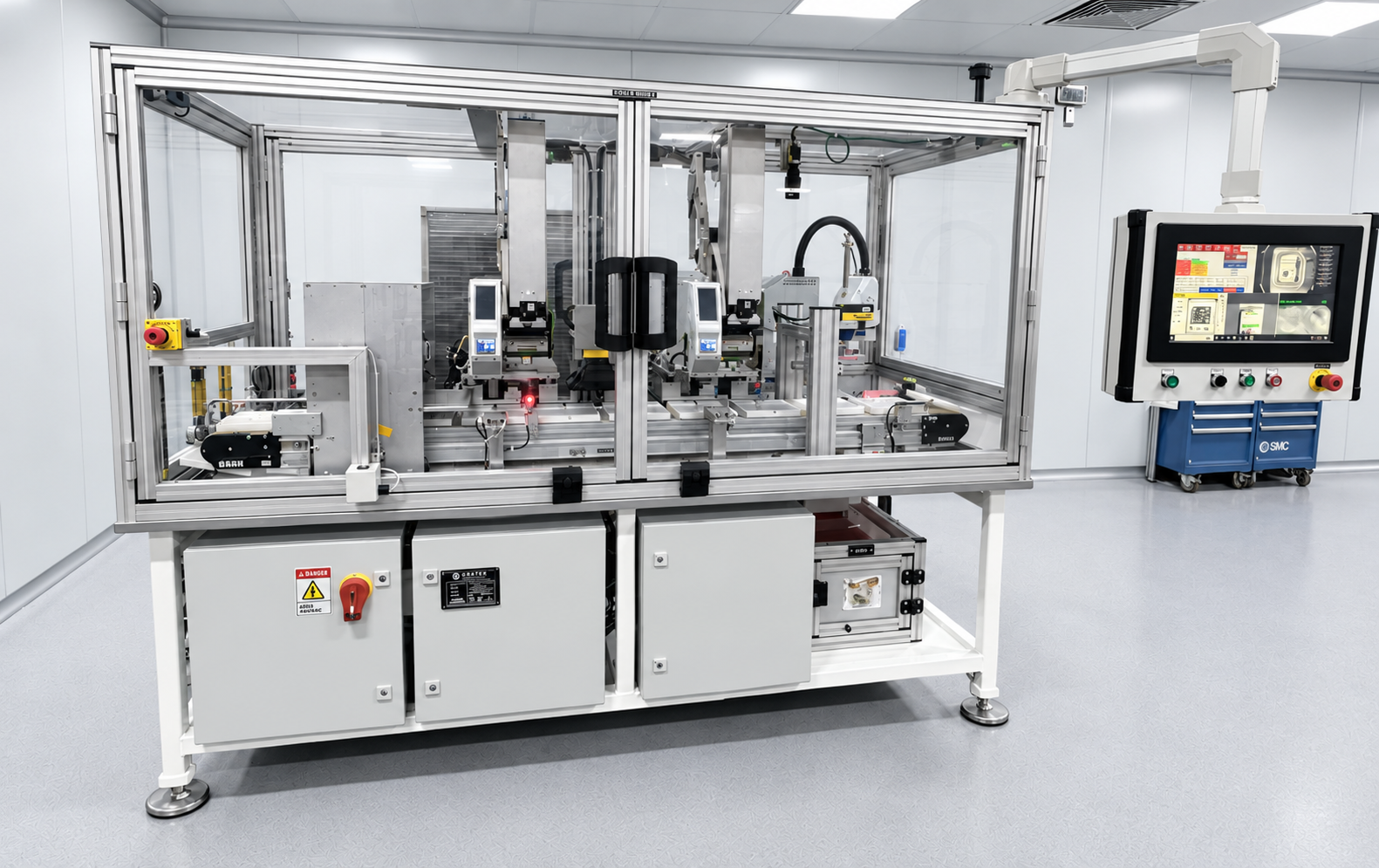
A pharmaceutical assembly line needs a record of what happened to each part throughout production. Manual collection of evidence, though, is prone to human variance and can even be a bottleneck on a fast-moving line.
The most efficient way to track whether the assembly met its defined requirements is with automated vision inspections and other pharmaceutical automation solutions. The repeatable production steps of a properly specified automation cell capture all the information compliance teams need to validate parts and processes.
CONTROLLED PART HANDLING = IMPROVED TRACEABILITY
Traceability is a hit or miss prospect if you have components leaving defined processes and passing through manual handling. Part of the issue is the risk of human error and the complication of repositioning components that have lost orientation or known location in loose bins between steps.
An automated cell ties all part movement data to discrete programmed operations. A component can retain a known position as it moves from press-side extraction all the way through assembly and inspection. Your automated cell might use a simple barcode (or other identification methods) to associate that movement with a particular lot or tray. The idea is to keep a nice, clean chain of information between physical parts and production data.
The controlled parts handling of pharmaceutical automation solutions exemplify the principles behind pharmaceutical GMP. As the World Health Organization explains, manufacturers need documented proof that defined procedures were consistently followed at each production step. Automation is the best way to collect and document that evidence in a consistent, continuous fashion.
AUTOMATED INSPECTION = MORE COMPLETE PRODUCTION RECORDS
It’s possible to record inspection results right at the point where the check occurs with automated vision and testing systems.
An inspection-equipped pharmaceutical automation cell verifies component presence and dimensional requirements in real time. You’re not limited to those measurements, though. Your team might want to record a leak-test result or confirm that an assembly reached the correct station. Combine each inspection into a single cell and save your human operators time.
The system stores the context of the results, too — a key to full compliance. The U.S. Food and Drug Administration guidance on data integrity states that CGMP data should remain reliable and accurate, with metadata that gives a result meaning. Contextual metadata helps associate information such as timestamps, user IDs or instrument information with the underlying measurements or other inspection data.
A simple pass/fail value on a clipboard lacks all of this value.
KEEP AN AUDIT TRAIL: YOUR ELECTRONIC RECORDS NEED HISTORY
Your automated system should record any changes to regulated production data.
The FDA describes an audit trail as a computer-generated record that reconstructs the creation, modification or deletion of an electronic record. An audit trail establishes a record of who changed a setting and when the change occurred. If something goes awry, such historical records are the key to traceability. They allow quality personnel to examine what happened during a specific production run.
TO MAINTAIN COMPLIANCE, YOU’LL STILL NEED VALIDATION
In and of itself, automation does not make a process “compliant.” The system still has to be consistent as it performs its intended function, and regulated computerized functions will still need appropriate validation.
Just as an example of such compliance requirements, the European Commission’s GMP Annex 11 states that computerized applications “should be validated” and that when replacing a manual operation with an automated one, “there should be no resultant decrease in product quality, process control or quality assurance.” These sorts of requirements are common, though obviously they’ll be unique to local regulatory organizations.
Define the inspection criteria, record requirements, and mechanical sequence in the specification phase. It’s important to validate and double-check for compliance early, before the automation cell has been engineered.
CONTACT JERIT FOR PHARMACEUTICAL AUTOMATION SOLUTIONS
Jerit Automation designs automated cells & equipment that combine part handling with assembly and testing. We regularly incorporate data collection throughout the system for simple traceability and compliance.
Bring Jerit into your next project while you’re still defining requirements. Our engineers are ready to review part movement through the line and advise you on the controls needed to preserve the production record from one step to the next. Contact us to discuss a custom pharmaceutical automation system for your application.
FAQS
What are pharmaceutical automation solutions?
Pharmaceutical automation solutions are systems that perform manufacturing operations such as handling, assembly, inspection and testing while controlling production sequences and collecting process data.
How does automation improve traceability?
Automation can associate production events with timestamps, identifiers, inspection results and other information that helps reconstruct the history of an assembly or batch.
What production data can an automation cell record?
Systems can capture inspection results, test values, process parameters, equipment status and identifiers tied to parts or production lots.
How does automated part handling support compliance?
Automated part handling reduces uncontrolled transfers between production steps and keeps component movement tied to defined machine sequences.
Are pharmaceutical automation systems automatically FDA compliant?
No. Compliance depends on system requirements, validation, operating procedures and the regulations applicable to the specific manufacturing process.
What role do audit trails play in pharmaceutical automation?
Audit trails record changes to electronic records and help establish who performed an action and when it occurred.
Why are user access controls important?
Access controls restrict regulated system functions to authorized personnel and help maintain accountability for changes made within the system.
When should compliance requirements be discussed with an automation integrator?
Compliance and data requirements should be established during system specification so validation needs and recordkeeping functions are incorporated into the automation design.