
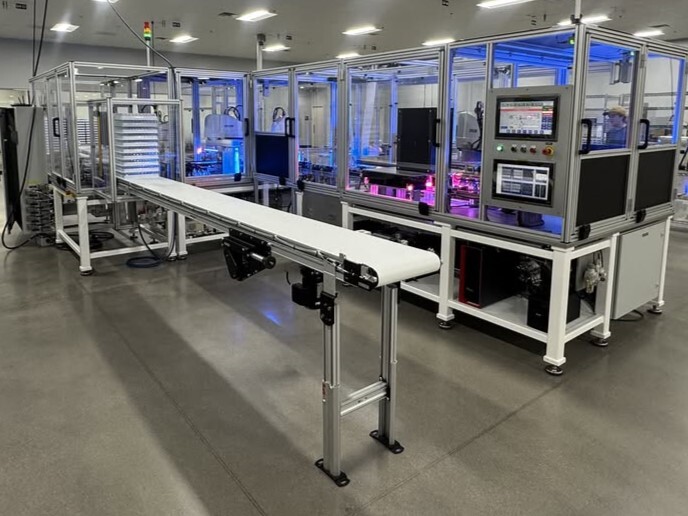
An off-the-shelf conveyor, robot, or packaging machine is a serviceable solution for numerous manufacturing applications. Standard equipment is proven and readily available. For those reasons, it can make for a fast path to production, too. Not every manufacturing problem calls for custom automation.
Still, some do. Custom automation systems are often the best solution when standard equipment cannot fully meet production needs.
STANDARD VS. CUSTOM AUTOMATION SOLUTIONS: ARE YOUR PRODUCTION GOALS LIMITED BY EQUIPMENT?
Standard equipment is a viable option when a proven machine already performs the job at the required speed and quality. Custom automation is the way to go when off-the-shelf equipment has limitations — in terms of scalability, integration, quality, or unique processes — that prevent it from meeting production goals.
In these cases, the production method itself requires engineering. In other words, a custom automation solution. A catalog machine can be attractive with the lower initial investment that comes with stock equipment.
However, you may achieve more overall ROI with a custom integrated automation system due to increased production efficiency. The smooth integrations and elimination of extra labor between steps will speed up cycle times, and a custom system can be planned for future production requirements with minimal production adjustments as you scale.
CHOOSE CUSTOM AUTOMATION TO OVERCOME THESE OFF-THE-SHELF LIMITATIONS
THE PART EXCEEDS STANDARD MACHINE CAPABILITIES
Part geometry is a major determining factor in the need for custom machinery. Flexible molded components may collapse under a standard gripper. Delicate surfaces could benefit from or even require highly controlled contact points. If you have large or heavy products that exceed the payload, fixture, or working-envelope limits of catalog equipment, you’ll need to commission something more specialized.
Custom automated machine design addresses physical requirements with dedicated tooling, fixtures, sensing, motion, and controls selected for the product. This is more effective than parts adapted from a general-purpose package.
SEVERAL OPERATIONS MUST RUN AS ONE PROCESS
A manufacturer may already have a press, test stand, vision system, and packaging machine. Each unit can perform properly while the overall line misses its cycle-time target.
Custom automation solutions can coordinate the transfers between those operations. The controls exchange production data, the handling equipment preserves orientation, and each station releases the part according to the same sequence. This type of automation system integration is perfect for new equipment that needs to communicate with legacy controls. It’s also important for the careful integrations necessary in high-mix manufacturing environments.
QUALITY REQUIREMENTS CALL FOR MORE DEDICATED INSPECTION
A standard inspection station may confirm presence, position, or basic dimensions. Some products require a more specific sequence.
You might set up custom automation equipment to inspect several features, connect results to a serial number, route failed parts, and store process data for later review — all in one continuous process. The inspection method can be incorporated right into the handling sequence, which removes a separate manual step from production.
CYCLE TIMES ARE TOO SLOW FOR HIGH PRODUCTION VOLUMES
Custom systems require design time, fabrication, programming, testing, and commissioning. The economics improve when the machine will run high volumes or save substantial labor. A custom approach may even remove an expensive constraint.
A project with a short production life or uncertain demand, however, may never generate enough savings to recover that investment. Expected cycle count matters as much as cycle time.
OFF-THE-SHELF SOLUTIONS ARE NOT A MANUFACTURING ADVANTAGE
A proprietary assembly/handling method or testing routine may allow your company to produce faster or meet a specification competitors struggle to reach. Catalog equipment gives every buyer access to the same general capability.
Custom factory automation can preserve the process that gives the manufacturer its advantage. The financial return here comes from higher throughput with tighter tolerances and lower scrap. Even more so if you have the ability to produce a part that standard machinery cannot handle.
WHICH SHOULD I CHOOSE?
You may opt for standard equipment for shorter runs or when you need equipment delivered from stock inventory immediately, but with proper planning, a custom approach allows you to optimize for fit, integration, quality, and process capabilities — all keys to ROI.
In short, custom automation is the best solution whenever standard, off-the-shelf equipment is unable to fully meet your production goals.
To put it another way, the question you should ask is whether you’re matching the process to the machine, or the machine to the process. If it's the latter, custom automation solutions are likely to deliver far greater value over the life of the equipment.
Get in touch today and let us know more about your project. We can design a solution for any stage of your automated assembly system.
FAQS
What are custom automation solutions?
Custom automation solutions are machines or production systems engineered for a specific product, process, facility, and output requirement. They may combine robotics, controls, tooling, inspection, testing, and material handling.
How is custom automation different from standard equipment?
Standard equipment is sold in repeatable configurations with published operating limits. Custom automation is designed around requirements that a catalog machine cannot meet efficiently.
Is custom automation always more expensive?
The initial price is generally higher because it includes application-specific engineering. Total cost may be lower when the system reduces labor, scrap, rework, downtime, or expensive modifications to standard equipment.
What information is needed for custom automated machine design?
An integrator will need part drawings or samples, process steps, cycle-time requirements, production volumes, quality criteria, facility constraints, existing equipment details, and safety requirements.
Can custom automation equipment connect to older machines?
Yes. Integrators can connect new controls and equipment to legacy systems using compatible communication hardware, I/O, sensors, and application-specific programming.
What production volumes justify custom factory automation?
There is no universal minimum. The decision depends on labor savings, cycle count, scrap reduction, downtime, product margin, and the expected service life of the equipment.
How long does custom automated equipment take to build?
Timelines vary with system size and complexity. Engineering, component lead times, fabrication, programming, runoff, installation, and commissioning all affect the schedule. Ask your automation system designer for an estimate.
Can a system combine standard and custom equipment?
Yes. Many effective systems use standard robots, conveyors, sensors, and controls with custom tooling, fixtures, programming, and integration. This approach limits unnecessary engineering while meeting the application requirements.